
Corriemoillie BESS Update
Garve and District Community Council
Added at 19:12 on 16 October 2025
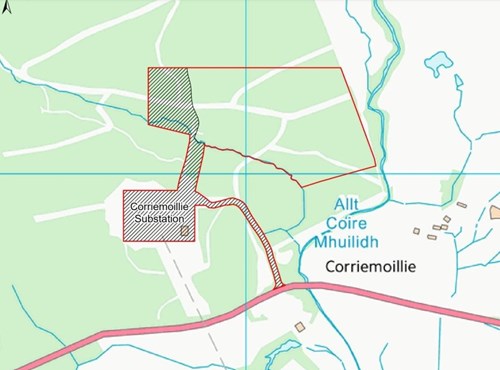
Highland Council ref. 24/05255/S36
ECU Ref. ECU00005155
The Highland Council have raised an objection to the Corriemoillie BESS application stating;-
"Further to reporting the Case Officer’s ongoing assessment of the application to the Chair of North Planning Applications Committee (NPAC), we can confirm that based on the submission made to date, the Council RAISE AN OBJECTION to the application for the following reasons:
The application does not accord with the provisions of Section 36 of the Electricity Act 1989 by virtue of not demonstrating sufficient regard to the desirability of, and failing to reasonably mitigate effects detrimental to, conserving flora and physiographical features of special interest by virtue of failing to demonstrate compliance with NPF4 Policies 11e) 4 and 6 by not adequately demonstrating that the proposal will not result in unacceptable impacts on protected species including bat and ornithological interests, and that the proposed woodland removal is justified and will be adequately compensated. Consequently, the proposal is contrary to the provisions of the Highland-wide Local Development Plan policies 28, 52, 58, and 67 and associated Supplementary Guidance. "
The full document can be viewed here https://bit.ly/Corriemoillie-BESS this application's final descion will be taken by the ECU
Update - 4th January 2026
The following has been sent to the ECU
ECU00005155 – Raise Objection - Corriemoillie BESS
https://www.energyconsents.scot/ApplicationDetails.aspx?cr=ECU00005155
Highland Council Ref 24/05255/S36
https://wam.highland.gov.uk/wam/applicationDetails.do?activeTab=documents&keyVal=SOP1URIH0JS00
Since the S36 Raise Objection from The Highland Council - the applicant has submitted new documents in view of this
Garve and District Community Council raise objection for reasons detailed below.
1. Failure to Address the Highland Council’s Objection – New Information Does Not Resolve the Fundamental Defect
The Highland Council has formally maintained an objection to the Section 36 application on the basis that the proposal fails to demonstrate sufficient regard to conserving flora and physiographical features, does not adequately justify woodland removal, and does not demonstrate that impacts on protected species (including bats and birds) will be acceptable or mitigated.
The newly submitted documents do not resolve these deficiencies, but instead introduce new uncertainty, particularly in relation to woodland loss compensation and biodiversity enhancement, reinforcing the Council’s position that the development cannot be supported as submitted.
2. Inappropriate and Unjustified Relocation of Compensatory Tree Planting (BNG)
a) Compensation Detached from Impact Location
The new Biodiversity Enhancement proposals relocate compensatory woodland planting away from the development site to land in Achnasheen, entirely disconnected from the affected habitat at Corriemoillie.
This undermines the principle of like-for-like, locally relevant compensation, and conflicts with NPF4 Policy 6 (Nature Networks and Biodiversity), which requires enhancement to be ecologically coherent and spatially relevant, and Highland LDP Policy 58, which requires mitigation to be proportionate and directly related to the impact.
Remote planting does not compensate for the loss of functional woodland habitat at the site, particularly for protected and site-faithful species.
b) Apparent Avoidance of On-Site Restocking Obligations
The compensatory planting now proposed appears to substitute land previously identified north of the site, which had already been cleared and is subject to forestry restocking obligations in any event.
This raises a serious concern that the proposal is double-counting mandatory restocking as biodiversity net gain and that BNG is being claimed for planting that would be required regardless of this development.
This directly undermines the credibility of the BNG calculations and fails the test of additionality, a core requirement of biodiversity enhancement under NPF4 Policy 6.
3. Woodland Loss Still Not Adequately Justified or Compensated
Despite the Arboricultural Impact Assessment update, the application still fails to demonstrate that woodland removal is unavoidable, that the scale of loss is minimised, or that compensation is equivalent in ecological function, maturity, and landscape value.
New planting proposals rely heavily on young transplants, which will take decades to replicate the habitat value of existing woodland—if they ever do—resulting in a significant temporal biodiversity deficit, contrary to Highland LDP Policy 28 and Policy 58.
This directly reinforces the Highland Council’s stated concern that woodland removal is not adequately justified or compensated.
4. Increased Landscape and Visual Harm Remains Unresolved
The updated Landscape and Visual Appraisal relies heavily on screening and future planting to mitigate impacts.
However, mitigation planting is long-term and uncertain, some planting is now relocated off-site, weakening visual mitigation at Corriemoillie itself, and the industrial character of the BESS remains incongruous within a rural and semi-natural landscape.
This approach fails to meet NPF4 Policy 4 (Natural Places) and Highland LDP Policy 67, which require development to respect landscape character, not defer mitigation to speculative future outcomes.
5. Continued Uncertainty Around Protected Species Impacts
The Highland Council explicitly cited insufficient information regarding bat and ornithological impacts.
The new submissions do not materially reduce uncertainty regarding habitat severance and displacement, rely on post-consent management and monitoring rather than avoidance, and remain dependent on habitat compensation that is now spatially removed from the impact zone.
This reinforces non-compliance with NPF4 Policy 11(e) and Policy 6, and fails the Section 36 duty to demonstrate adequate mitigation for protected species impacts.
6. Planning Balance – New Information Weighs Against Consent, Not in Favour
Rather than resolving objections, the new documents weaken the integrity of the biodiversity strategy, introduce concerns over additionality and deliverability, reduce confidence in woodland and habitat compensation, and confirm that mitigation is deferred, uncertain, and remote.
The subsequently submitted Statutory Biodiversity Metric spreadsheet and Post-Submission Additional Documents application form do not materially alter the planning balance, introduce no new mitigation, and instead confirm that the proposal’s claimed biodiversity gains remain dependent on remote, non-additional compensation.
As such, the planning balance is further tilted against consent, consistent with the Highland Council’s conclusion that officers are minded the proposal cannot be supported.
In light of the Highland Council’s maintained objection, and given that the newly submitted information fails to address—and in several respects exacerbates—the fundamental concerns previously identified, this application remains contrary to Section 36 of the Electricity Act 1989, NPF4 Policies 4, 6 and 11(e), and the Highland-wide Local Development Plan. The proposed development should therefore continue to be refused.