
A Further Delay on the A835 Repair at Check Rail Corner
Garve and District Community Council
Added at 10:09 on 20 November 2025
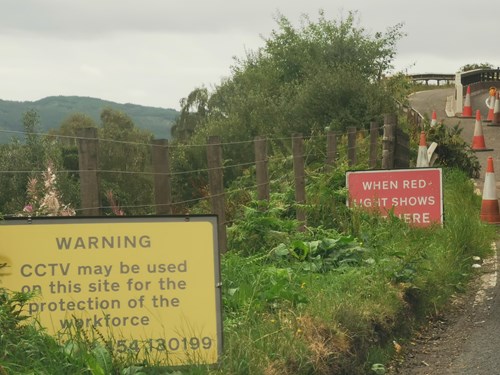
Unfortunately this morning's news brings yet another delay in resect of the A835 repair by Loch Garve, known locally as Check Rail Corner.
Having not recieved the update we were promised we got intouch again asking 4 direct questions and complained about the lights being out of order Friday evening, Staurday moring and again on Monday morning.
We asked -
1. Has a contractor been appointed now?
2. Who is the contractor?
3. Has the contract been signed?
4. When have they agreed to start work?
Today's news ...
"We are in the final stages of awarding the tender and expect this to be finalised by the end of November meaning we are programmed to mobilise to site for late January. Once the tender is awarded we will issue a press release. Again, I can only thank you and the Garve local community for your patience as we continue to progress this scheme.
I have discussed the lights issue with our Operations team and of course highlighted the unacceptable situation. Our teams complete daily checks and maintenance of the lights but we will increase this to twice daily to ensure they are operating as planned. Our lights are set to go red-red when they detect a driver going through on a red light for safety reasons so, if the lights are being maintained as they should, this may be the reason for the red-red. I'll continue to keep in touch with our Operations team to ensure these maintenance checks are carried out. "
Suffice to say road users have no choice in being patient and are fed up with excuse after excuse!
As always we will update everyone as news is recieved, good or bad.
Meanwhile people have asked - why that stretch is known locally as Check Rail Corner ...
The Quiet Safety Feature Most Rail Passengers Never Notice
Tucked alongside the main rails on certain stretches of track is a small but vital piece of railway engineering that many people never spot — the check rail. Modest in appearance, it plays a big role in keeping trains safely on track.
Rather than carrying the weight of the train, a check rail acts as a guide. It sits just inside the main running rail and works with the flanges — the inner lips of a train’s wheels. These flanges are designed to keep wheels from slipping off the rails, and the check rail gives them an extra surface to bear against when conditions get tricky.
Why they matter
Railways aren’t always straight, level, and perfectly stable. On tight curves, steep gradients, or areas where the ground may shift or settle unevenly, trains experience extra sideways forces. Without guidance, wheel flanges can climb the rail head — one of the key causes of derailments. Check rails reduce this risk by keeping wheels correctly aligned, preventing sideways movement from becoming dangerous.
They also have an important job at points (switches). Here, tracks split or cross, creating complex gaps in the rails. At the crossing — often called the frog — there’s a risk a wheel flange could take the wrong path. Check rails steer the wheel flanges so they pass safely through on the correct side, maintaining a smooth and secure route.
Where you’d typically find them
Check rails were most commonly installed in higher-risk locations, including:
- Sharp or heavily curved sections of line
- Inclines and areas with changing levels between rails
- Track laid over less stable or uneven ground
- Complex trackwork such as points and crossings
In all these places, their role is the same: control and guidance, rather than load-bearing.
Not just full-size railways
Their importance carries over into model railways too. Enthusiasts often include check rails in points and tricky layouts for exactly the same reason as the real thing — to guide wheel flanges and reduce the chance of derailments. In smaller scales, where tolerances are tighter, that extra guidance can make a big difference to smooth running.
A small addition with a big safety impact
Check rails might look like a minor add-on, but they represent a clever bit of preventative engineering. By giving wheels a controlled path in the places they’re most likely to wander, they quietly improve stability, reliability, and overall railway safety whether on a full-size main line or a layout on a living room table.